Wednesday, November 30, 2022

Google Doodle honours 'father of modern gaming' Jerry Lawson on his 82nd birth anniversary

Known for dedicating creative and unique doodles toward some significant events and personalities, Google Doodle is celebrating the 82nd birth anniversary of video game pioneer, Gerald “Jerry” Lawson today, 1 December. Known as one of the fathers of modern gaming, Jerry Lawson is credited for developing the world’s first video game console and further for leading the group that developed the first commercial video game cartridge. Speaking today’s Google Doodle, is an interesting concept that gives you the option to play a short video game.

Designed by three American guest artists and game designers Davionne Gooden, Lauren Brown, and Momo Pixel, the interactive game takes you to a vintage video game interface where there are different options to select from. While there are different game levels and options to edit the levels, you can also opt to read about Lawson and his history. The games offer a peek into the graphics and look of early games’.

The doodle also uses the typical gaming sound throughout the session.

https://twitter.com/Doodle123_EN/status/1598093319732600833

Who was Jerry Lawson?
Born on 1 December 1940, Lawson took interest in electronics from a very young age and later pursued an education in the same field. He started his career with Fairchild Semiconductor where he led the team for the development of the Fairchild Channel F system, the first home video game system console which had interchangeable game cartridges, an 8-way digital joystick, and a pause menu.

Following this landmark feat, he later left Fairchild and started his own video game development company, VideoSoft which created the software for the Atari 2600. While his stint with the company was for just a few years before they closed, Lawson had already created a place for himself in the industry. Throughout the rest of his career, he established himself as a pioneer in video gaming and also consulted with several companies. He passed away in 2011.

Read all the Latest News, Trending News, Cricket News, Bollywood News,
India News and Entertainment News here. Follow us on Facebook, Twitter and Instagram.


from Firstpost World Latest News https://ift.tt/9i2rYFf

World AIDS Day 2022: Theme, history, significance and all you need to know about this fatal disease

Every year on 1 December, World AIDS Day is observed all across the world to raise awareness about the life-threatening disease. It serves as an opportunity for people to unite together in the battle against HIV which stands for Human Immunodeficiency Virus. The particular day aims to support individuals who are living with this virus and to remember those who lost their lives due to an AIDS-related illness.

AIDS is the most severe form of HIV, a virus that damages specific immune system cells. It is brought on by the deadly infection of HIV and it gradually destroys the patient’s immune system, significantly lowering the body’s ability to fight off other diseases.

World AIDS Day 2022 Theme:

The theme for this year’s World AIDS Day is ‘Equalize’. It urges world leaders and citizens to openly acknowledge and solve the inequalities that are hindering efforts to eliminate AIDS and to ensure that everyone has equitable access to necessary HIV care.

World Health Organisation (WHO) has recognised some behaviours and conditions that increases the risk of contracting HIV:

Having sex without any protection.
Carrying another STI, such as syphilis, herpes, chlamydia, gonorrhoea, or bacterial vaginosis.
Indulging in dangerous alcohol and drug use while performing sexual activity.
Exchanging contaminated needles, syringes, and other injecting tools and chemical solutions when injecting drugs.
Receiving toxic injections, tissue transplants, blood transfusions, and surgical operations requiring sterile cutting or piercing.
Experiencing unintended needle stick injuries, especially among medical professionals.

History of World AIDS Day:

James W. Bunn and Thomas Netter established the first World AIDS Day in August 1988. They attempted to give the pandemic, which had killed so many people at the time, the impression of being under control. Since 1981 when the disease was first recognized, over 33 million people have been infected with HIV, and over 25 million people have died of AIDS within 20 years. Following the surge, Bunn and Netter informed the program director, Dr Johnathan Mann, and gave him the idea to designate a special day for the celebration. After that, Mann proclaimed 1 December as World AIDS Day and it still persists.

Significance of World AIDS Day:

By the end of 2021, there were over 38.4 million HIV-positive patients worldwide, 25.6 million of whom reside in the WHO African Region. Over 4,139 people in the UK receive an HIV diagnosis each year, and stigma and prejudice are still prevalent for many of those who live with the illness. World AIDS Day serves as a reminder to both the general public and the government that the issue is a serious one that calls for immediate funding, education, eradication of prejudice, and enhancement of educational opportunities.

Read all the Latest News, Trending NewsCricket News, Bollywood News,
India News and Entertainment News here. Follow us on Facebook, Twitter and Instagram.


from Firstpost World Latest News https://ift.tt/LV2yE5N

Watch: Chinese human rights lawyer Yu Wensheng, his wife kept under house arrest by men in hazmat suits

New Delhi: Protests in China against Xi Jinping’s stringent zero-Covid policy are on the rise and it has now spread to several cities. Chinese authorities have moved quickly to suppress demonstrations deploying police forces at key protest sites and tightening online censorship.

In a twitter post, several men in hazmat suits were seen stopping Chinese human rights lawyer Yu Wensheng, and his wife Xu Yan when they tried to go downstairs to throw out garbage. Both were later put under house arrest. Xu Yan in the twitter post also claimed that the men in hazmat suits did not tell them their names and titles.

Watch:

In another video, both Yu and a man in hazmat suit were seen lying on the ground, and the reason for that remains unknown.

Soon after been put under house arrest, Yu Wensheng posted a video on twitter and said, “Xu Yan and I are now locked up at home. Their behavior is not only a crime against us personally, but a crime against the entire Chinese people and the people of the world. We firmly oppose their zero-Covid policy.”

He also issued a letter and urged world leaders to press the Chinese government to end its repressive zero-Covid policy.

Read all the Latest News, Trending News, Cricket News, Bollywood News,
India News and Entertainment News here. Follow us on Facebook, Twitter and Instagram.


from Firstpost World Latest News https://ift.tt/SIHkfP2

China: Demonstrators attack police in Guangzhou as protests against Covid-19 lockdown escalate

Guangzhou (China): Hundreds of protesters clashed with police in the industrial hub of Guangzhou in southern China as public anger against the stringent Zero Covid policy of the Chinese government and resultant hard COVID-19 lockdown boiled over, three years into the coronavirus pandemic.

The violence in Guangzhou was a marked escalation from similar protests in Shanghai, Beijing and other Chinese cities over the weekend. The current wave of country wide protests in biggest wave of civil disobedience in China since Xi Jinping started his reign as president a decade ago.

The COVID-19 pandemic and the subsequent Zero Covid policy has hit the Chinese economy hard and after decades of breakneck growth.

According to posts on social media platforms, the clashes in Guangzhou took place on Tuesday night when members of the public had an argument with policemen over lockdown curbs.

News agency Reuters reported that authorities in Guangzhou did not immediately respond to a request for comment.

Read all the Latest News, Trending NewsCricket News, Bollywood News,
India News and Entertainment News here. Follow us on Facebook, Twitter and Instagram.


from Firstpost World Latest News https://ift.tt/kxIuZYV

Tuesday, November 29, 2022

Pakistan: Dozens injured as Taliban suicide bomber targets police patrol in Quetta

Quetta (Pakistan): With the Pakistan Taliban declaring an end to its truce with the government and ordering nationwide attacks, the repercussions of that decision have already started taking a toll on Pakistan’s security forces.

On Wednesday, a police vehicle was bombed by a suicide bomber in Pakistan’s southwestern city of Quetta, the capital of restive Balochistan province. At least three people were killed and around 28 were injured in the blast targeting the police patrol.

The Tehreek-e-Taliban Pakistan (TTP) has claimed responsibility for the suicide attack.

Police officer Abdul Haq told news agency Reuters that a police patrol was targeted in an attack by a suicide bomber. A total of 21 people including 15 police officers were injured in this attack.

He also informed that the injured have been taken to the Civil Hospital in Quetta. He said that the area has been cordoned off and investigation has been started. According to the initial information, the police personnel were on duty to protect a vaccination team.

Balochistan Chief Minister condemns attack

Balochistan Chief Minister Abdul Quddus Bizenjo condemned the attack and directed the authorities to provide better treatment facilities to the injured.

He also promised that such cowardly acts will not dampen the determination of Balochistan to establish peace. Bizenjo said that all elements involved in the incident would be brought to book and punished severely.

Attacks common in Quetta

In August 2022, at least three people, including a policeman, were injured in a blast that was triggered by remote control in the Hajar Ganji area of ​​Quetta. In another similar incident, a person was killed in a grenade explosion in Quetta. At least 11 other people were injured.

Read all the Latest News, Trending NewsCricket News, Bollywood News,
India News and Entertainment News here. Follow us on Facebook, Twitter and Instagram.


from Firstpost World Latest News https://ift.tt/BEgOt6G

The Awakening: How scientists have revived a 48,500-years-old 'zombie virus'

Picture this: scientists in lab coats trying to reanimate viruses extracted from lands and lakes that had been frozen many years ago. Sounds no less than a plot of science fiction, right?

But it has happened and is very much a reality. A team of researchers from different parts of Europe examined samples collected from permafrost in Russia’s Siberia.

The new study has raised concerns about the thawing of permafrost – land that constantly remains below zero degrees Celsius – due to climate change. Researchers say that this may pose a new threat to humans and animals.

The study, which is yet to be peer-reviewed and is in the preprint stage, has been published on bioRxiv. As a part of the study, scientists have revived and characterised 13 new pathogens or what they have termed “zombie viruses” and this bunch includes one which is more than 48,500 years old.

Let’s take a closer look at the study.

The viruses that were uncovered

The team of scientists behind the study was led by microbiologist Jean-Marie Alempic from the French National Centre for Scientific Research. Ranging between the ages of 27,000 to 48, 500, awakening these viruses could potentially pose a threat to public health and further study is required to assess the dangers of the pathogens that remained unknown to mankind.

While conducting their study, researchers established that each of the viruses that have been extracted from the thawing icy cold surfaces of Siberia were distinct from all the known existing viruses in terms of their genome.

Also read: Explained: What is ‘Disease X’ that WHO believes can cause future pandemics?

The oldest of these “zombie viruses” has been identified as Pandoravirus yedoma which has set a record age for a frozen virus capable of returning to a state of infecting other organisms. During the early phase of its isolation process, the virus was visible under a light microscope.

A virus named Cedratviruses was extracted from Russia’s Lena River, the Kamchatka peninsula and from the mud flowing into the Kolyma River. One sample of Pithoviruses was even collected from a large amount of mammoth wool.

Although Pacmanviruses were recently associated with some cases of swine fever in Africa, scientists have now reported a new variant of this virus that was found in the frozen intestinal remains of a Siberian wolf and are 27,000 years old.

As permafrost continues to thaw as a result of increased temperatures due to climate change, it is yet to be determined how infectious these viruses can get once they are exposed to light, heat and oxygen.

Scientists flag concerns

The release of these largely unknown viruses from their icy slumber is bad news. The study also highlights the detrimental effects of climate change.

The researchers wrote, “Due to climate warming, irreversibly thawing permafrost is releasing organic matter frozen for up to a million years, most of which decomposes into carbon dioxide and methane, further enhancing the greenhouse effect.”

According to a report by Bloomberg, says that the biological risk of reanimating the viruses was, however, “negligible” due to the strains they have targeted which are mainly capable of infecting amoeba microbes. But the potential and eventual revival of a virus that could infect other organisms can be a real danger.

“But the risk is bound to increase in the context of global warming when permafrost thawing will keep accelerating, and more people will be populating the Arctic in the wake of industrial ventures,” they said.

“It is thus likely that ancient permafrost will release these unknown viruses upon thawing. How long these viruses could remain infectious once exposed to outdoor conditions, and how likely they will be to encounter and infect a suitable host in the interval, is yet impossible to estimate,” the scientists added.

Impacts of permafrost thaw

According to Natural Resources Defence Council, the impacts of the continued thawing of permafrost are widespread.

Nearly 85 per cent of the regions around Siberia, Canada, Greenland and Alaska sit atop a layer of permafrost. In the northern hemisphere, permafrost accounts for an estimated nine million square miles of land.

A recent study suggests that for every one degree Celsius rise in temperature, an additional 1.5 million square miles of permafrost could eventually disappear.

Defrosting can release harmful gases like carbon dioxide and methane into the air from the decomposed bodies of plants and animals which are essentially trapped in the ice and helps in preserving these global warming gases.

Thawing permafrost can also significantly alter existing landscapes by creating areas of sagging ground and shallow ponds. It can also make frozen soil more vulnerable to landslides and erosions.

With inputs from agencies

Read all the Latest NewsTrending NewsCricket NewsBollywood News,
India News and Entertainment News here. Follow us on FacebookTwitter and Instagram.


from Firstpost World Latest News https://ift.tt/AGFMd3X

Iran’s World Cup dream over, but struggle for women’s rights and freedom continues

“I am not afraid to talk, even if I go to prison.”

It’s three hours to kick off and the atmosphere near the Al Thumama Stadium, the exterior of which is shaped in the motif of the woven cap Taqiyah, is dense, thick with tension and apprehension. Iranian fans, a mix of home-based supporters and the diaspora, are mulling about, but at the same time watching each other carefully: Who is pro-regime? Who isn’t? Who is wearing a message of support for the nationwide protesters? It seemed that the match between the United States and the Islamic Republic of Iran was just about the last thing on everyone’s mind.

FIFA World Cup: Fixtures | Results | Points Table | Squads | Records

It’s also how Iran got their World Cup campaign underway – with an improbable 6-2 defeat to England. The players had fallen victim to the pressure cooker and political ramifications that involve playing for Team Melli, but, perhaps, the match against the United States represented, given the geopolitical backdrop and the on-field stakes, an encounter of a different magnitude altogether.

The diplomatic feud over the removal of official emblem and two lines of Islamic script from its flag, a tense pre-match news conference, and the endless conjecture over the ins-and-out of Team Melli all formed a part of the rich tapestry of this match, not quite the mother of all games, but it came quite close. This game transcended the sport, at least from the Iranian perspective. It was not the geopolitical shock of the late 90s when the pair met at the World Cup in France, but, again, a flashpoint for the nationwide protests back home prompted by the death of Mahsa Amini in custody of the morality police.

Except, at the Al Thumama Stadium, pictures or drawings of Amini were conspicuously absent. At Iran’s first match, supporters were asked to wear their Amini T-shirts inside out when entering the stadium, at the second match such T-shirts were simply confiscated, and for the USA match supporters simply left them at home.

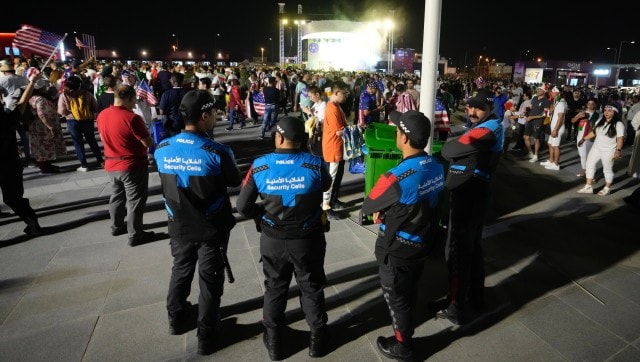
Qatar police officers stand as fans arrive ahead of the World Cup group B soccer match between Iran and the United States at the Al Thumama Stadium in Doha, Qatar, Tuesday, Nov. 29, 2022. (AP Photo/Luca Bruno)

They were wise to do so. Amid all the controversy over the ban on the OneLove armband, a protest against treatment of LGBTQ community in Qatar by some European federations, and other political symbols at World Cup venues, security was tightened at Iran – USA match.

On the surface, Americans and Iranians were fraternising, but that joviality masked husked voices and whispers. Iranian fan Saba, draped in an Iranian flag and with an American flag painted on both her cheeks, was asked to show her bra to ensure she was not hiding ‘dissenting’ messages.

All Palestinian flags, a prominent feature at this tournament, even at Qatar’s final World Cup match against the Netherlands, were confiscated as well. A family had their Persian flag removed, prompting a young girl to burst into tears.

“We want to be the voice of Iranian women, but they don’t let us talk,” said Saba. “Are you going to show your underwear? It’s the Iranian government controlling. It’s very scary. I am feeling safer around Americans than with these guys. It’s full of spies. They are taking photos. Who knows what plan they have for us – are they going to try to kidnap me?”

But, while organisers banned protests, they couldn’t keep them out entirely. On her left arm, Naba, a member of the diaspora as well, had painted the words ‘Women, life, freedom’, a rallying cry of the protesters. She felt conflicted. She said: “There is so much pressure on them, I can’t blame the team [for not speaking up more]. I want Iran to win, but I don’t want Iran to win.”

“This is the most brutal regime,” added Saba. “The amount of bloodshed is insane.”

Once inside the ground, Iranian fans, including thousands of pro-regime supporters, produced deafening decibels, generating the best atmosphere yet at the World Cup. Reluctantly, Iran’s players sang the national anthem, but at the end, they all bowed their heads, a significant gesture.

In the stands, security pounced at those who had smuggled in protest signs. They ripped up a sign with presumably the name of Mahsa Amini on it. Out of 483 journalists in the press box, two were detained briefly for photographing or filming incidents that organisers didn’t want the world to see. There was a skirmish after the match between pro-regime fans and protesters.

Ultimately, the match itself mattered a little less. In a chaotic and frantic finale Iran, 1-0 behind following a Christian Pulisic goal, claimed a penalty for a foul by Carter-Vickers. Iran’s players pleaded with referee Mateu Lahoz, even minutes after the final whistle.

By then, Carlos Queiroz, often a fiery character, had already shaken the Spaniard’s hand and conceded defeat. Saeid Ezatolahi was in tears. He was not the only one. Iran’s World Cup is over, but the struggle for women’s rights and freedom isn’t.

Read all the Latest News, Trending NewsCricket News, Bollywood NewsIndia News and Entertainment News here. Follow us on Facebook, Twitter and Instagram.


from Firstpost World Latest News https://ift.tt/HuI9oJs

Pakistan foreign minister Hina Rabbani Khar meets Afghan counterpart, top Taliban leaders in Kabul

Kabul: Pakistan’s Minister of State for Foreign Affairs Hina Rabbani Khar met the acting Foreign Minister of Afghanistan in Kabul on Tuesday.

The Taliban rulers of Afghanistan have not yet been formally recognized by foreign governments.

The meeting took place a day after the Pakistan Taliban (TTP) declared that it will no longer observe a month-long ceasefire with the Pakistani government, raising security concerns in areas bordering Afghanistan.

The Afghan Taliban has been facilitating peace talks between local militants and Pakistan officials since late last year.

It is not clear whether security concerns were discussed during the meeting between Pakistan’s Minister of State Hina Rabbani Khar and Amir Khan Muttaki, Acting Foreign Minister of Afghanistan.

“Several bilateral issues of common interest including education, health, trade and investment, regional connectivity, people-to-people contact and cooperation in socioeconomic projects were discussed,” Pakistan’s Foreign Office said in a statement.

A statement from Afghanistan’s foreign ministry said Muttaki also raised the issue of expediting trade and transit and facilities for travelers between the two countries, as well as the release of Afghan prisoners in Pakistan.

Pakistan this month reopened a key Afghan border crossing that was closed to trade and transit following clashes between security forces on both sides.

Some on social media highlighted the fact that a woman is leading Pakistan’s delegation at a time when UN and Western officials have called on the Taliban to change course on women’s rights.

The Taliban say they respect women’s rights in line with their vision of Islam and Afghan culture. Ever since the Taliban took over Afghanistan in August 2021, there have been clashes between their security forces and those of Pakistan, and extremists have attacked Pakistani forces.

Pakistan has called on the Taliban to ensure that they live up to the promise that they will not harbor international terrorists. On this, the Taliban has refused to give shelter to the terrorists.

The Taliban has not been recognized by any country yet. The Taliban quickly and easily took over Afghanistan in August 2021, after which President Ashraf Ghani fled the country and his government fell.

Read all the Latest News, Trending NewsCricket News, Bollywood News,
India News and Entertainment News here. Follow us on Facebook, Twitter and Instagram.


from Firstpost World Latest News https://ift.tt/qJj6SXv

Watch: Hindu temple vandalised, burgled in Pakistan

Islamabad: An old Ramapir Hindu Temple in the Naukot region of Pakistan’s Tharparkar was vandalised and money was stolen by miscreants, local media reported.

In a video going viral on social media, desecrated idols in the temple can be seen, while the thieves ran away after stealing the money.

However, local police is yet to take action in the matter, according to reports.

Few months back, idols at a Hindu temple in Pakistan’s Karachi city were destroyed in another incident of vandalism against places of worship of the minority community in the country.

The incident took place at the Shri Mari Maata Mandir in Karachi’s Korangi area on June 8.

(With inputs from agencies)

Read all the Latest News, Trending NewsCricket News, Bollywood News,
India News and Entertainment News here. Follow us on Facebook, Twitter and Instagram.


from Firstpost World Latest News https://ift.tt/alxLnvN

Monday, November 28, 2022

Viral Video: UK family left in shock after fox breaks into their home

Time and again, the internet has brought forth footage of incidents, wherein wild animals entered the residential area and were captured on CCTV. History is witness, several incidents have seen the daylight where Indians struggled after a leopard or a massive snake entered the residential areas. While such cases are also common abroad, foreigners usually handled a giant bear that trespassed their vicinity. But rarely did we come across an incident, wherein a fox has broken into a house. Well, it not only sneaked into a house but also found a corner for itself and sat there comfortably. Yes, you read that right. In a scene resembling a childhood tale, a family in the United Kingdom was left in shock, after they discovered their wrecked house and a fox calmly sleeping on their kitchen countertop. The incident came to light after an Instagram page shared a video of the entire incident.

According to the caption of the video, the incident took place on the morning of 18 November, when Emma Slade and her family went out to walk their dog, and accidentally left their door behind them open. And after returning from their nice walk, they found their house in a mess. While sharing the video, the Instagram page wrote in the caption, “Tired: Fox in the henhouse. Wired: Fox in YOUR house. That’s what happened to a family in the UK when they accidentally left their door open to walk their dog on the morning of Nov 18. They came home to find the mess you see in the video — and one very large fox just chillin’ on their countertop. ‘I was quite scared at first, but it didn’t even flinch or want to move at all,’ said Emma Slade, 39, via SWNS. ‘I’ve kept my backdoor shut since!’”

The now-viral video opens by showing a fox sitting at the corner of a countertop in a kitchen, which has been turned into trash. While the dustbins have been left upside down with their trash spread everywhere in the kitchen, the scenario appears as if the sly fox tried to look for food. The video begins with a woman behind the camera saying, “Does anyone know what one is supposed to do with a fox just sitting in my kitchen.” Then a man can be seen petting the animal by rubbing its back and neck. Despite being a wildlife creature and being patted by a human being, the fox sat there undisturbed and didn’t move a bit. Later on, the man can be seen picking the fox like a dog and leaving it out of the house. The video also shares a glimpse of their pet dog named Bear.

So far, the video has been viewed more than 4.6 lakh times and has garnered over 17,000 likes.

Read all the Latest News, Trending NewsCricket News, Bollywood News,
India News and Entertainment News here. Follow us on Facebook, Twitter and Instagram.


from Firstpost World Latest News https://ift.tt/BI0zh5q

WATCH: Chinese police patrol orders people to delete content on their smartphones

Chinese security forces on Monday filled the streets of Beijing and Shanghai following online calls for another night of protests to demand political freedoms and an end to Covid lockdowns.

In a video, a Chinese police patrol can be seen ordering people to delete content on their smartphones on Urumqi street in downtown Shanghai.

People have taken to the streets in major cities and gathered at university campuses across China in a wave of nationwide protests not seen since pro-democracy rallies in 1989 were crushed.

A deadly fire last week in Urumqi, the capital of northwest China's Xinjiang region, was the catalyst for public anger, with many blaming Covid-19 lockdowns for hampering rescue efforts.

Beijing has accused "forces with ulterior motives" of linking the fire to Covid measures.

At an area in the economic hub of Shanghai where demonstrators gathered at the weekend, AFP witnessed police leading three people away. China's online censorship machine also worked to scrub signs of the social media-driven rallies.

With inputs from agencies

Read all the Latest News, Trending NewsCricket News, Bollywood News,
India News and Entertainment News here. Follow us on Facebook, Twitter and Instagram.


from Firstpost World Latest News https://ift.tt/amZxG2I

Explained: What's next for China after mass COVID-19 protests?

Public protests in China related to the government’s COVID-19 restrictions have hit the news worldwide over the weekend, following a fatal apartment fire in Urumqi, Xinjiang last week which killed ten people.

Many internet users claimed some residents could not escape because the apartment building was partially locked down, though authorities denied this.

There have been reports some demonstrators have called for President Xi Jinping, the newly re-elected General Secretary of the Communist Party of China, to stand down. Others have criticised the rule of the party itself.

China’s COVID measures are among the strictest in the world, as it continues to pursue lockdowns to suppress the virus — what it calls a “dynamic zero COVID” policy.

While these protests are certainly serious challenges to authority, they should be kept in perspective. In particular, there’s no real parallel to those in Tiananmen Square in 1989. These are street protests where the demonstrators disperse after marching and protesting, and the main focus of the protests are the COVID restrictions rather than wider political principles.

The main issue here is frustration not just with COVID restrictions, but the inconsistent ways these measures are being implemented.

At least in the short-term, the state’s reactions are likely to be muted. There’s undoubtedly pressure for change, though how this will be achieved is hard to predict.

A more national response

Protests in China have actually become quite common in the last couple of decades, though they almost always centre around a specific issue and are highly localised.

Workers in a factory may protest over lack of payment or deteriorating conditions. Villagers forced to resettle so that their land can be redeveloped attempt resistance, sometimes even to the extent of refusing to be moved away. Residents in new housing estates become mobilised to complain about the lack of promised roads, retail outlets and services.

These kinds of protest are usually resolved reasonably and quickly not least by state officials intervening to ensure solutions in the name of maintaining stability.

Less capable of such instant solution are protests about more general principles, such as freedom of expression, legal representation, or governmental responsibilities. In such cases, government responses have tended to suppress the concerns.

But such protests have almost always been localised and not led to any sense of a regional or national movement. This has even been true of industrial disputes where workers have protested in one or more factories under a single brand or owner.

There’s no evidence at this stage that this is an organised national movement. But it seems protesters in each city have been emboldened by the actions of demonstrators in others.

Reading China’s social media it’s clear, for example, that demonstrators in Beijing and Shanghai report on each others’ protests, as well as commenting on the initial protest causes in Urumqi.

To date, police reactions have varied between locations. Some police were said to have been allowing demonstrations to continue.

But in other places, minor scuffles have been reported, including some arrests.

Off the streets and away from the demonstrators, asymptomatic residents of apartment blocks in lockdown have occasionally continued to protest.

Student demands

Some 40 students at China’s leading Peking University issued a declaration on Sunday that criticised “the implementation of the dynamic zero policy”. They said the COVID-zero policies had an increasing number of problems and have led to “horrible tragedies”, though they also acknowledged the importance and effectiveness of the safety measures implemented earlier in the pandemic.

They also said, “The most urgent task now is to find a temporary way of coexistence that minimises the danger of the epidemic while ensuring basic social order and basic economic and livelihood needs”.

To this end, they propose five key measures:

  1. “To avoid the abuse of public power, all regional quarantine blockades should be stopped to ensure that all people in communities, villages, units and schools can enter and leave freely”
  2. “Abolish technical means to monitor the whereabouts of citizens, such as pass codes and [health code] cell phone tracking app. Stop considering the spread of the epidemic as the responsibility of certain individuals or institutions. Devote resources to long-term work such as vaccine, drug development and hospital construction”
  3. “Implement voluntary [PCR] testing and voluntary quarantine for undiagnosed and asymptomatic individuals”
  4. “Liberalise restrictions on the expression of public opinion and allow suggestions and criticism of specific implementation problems in different regions”
  5. “Make truthful disclosures of infection data, including the number of infected people, the death rate, long [COVID] rate, to eliminate epidemic panic during the transition”.

The key issues are how to move from the current “dynamic zero COVID” policy towards something else, and indeed what that should be, given the inadequate health coverage in much of the country.The Conversation

This article is republished from The Conversation under a Creative Commons license. Read the original article.

Read all the Latest News, Trending News, Cricket News, Bollywood News,
India News and Entertainment News here. Follow us on Facebook, Twitter and Instagram.


from Firstpost World Latest News https://ift.tt/GbrwxmI

International Day of Solidarity with Palestinian People 2022: History and significance

Each year, International Day of Solidarity with Palestinian People is commemorated on 29 November. The day is observed to educate the public on the issue of Palestine and support a peaceful settlement between Israelis and Palestinians. Since 2008, the United Nations Office for the Coordination of Humanitarian Affairs (OCHA) has been keeping a track on the casualties in the Israeli-Palestinian conflict. As per its data, 5,600 Palestinians died till 2020, and 115,000 were injured in the long-running conflict. During the same period, 250 Israelis lost their lives and 5,600 were injured. The violence was  especially high during 2014, when Operation Protective Edge in Gaza was conducted by the Israel in response to the kidnapping and murder of three teenagers, as per a report by Statista.

History

The United Nations General Assembly (UNGA) declared  29 November to be observed annually as the International Day of Solidarity with the Palestinian People in 1977. In 1947, UNGA had adopted the resolution on the partition of Palestine on 29 November. On 14 May, 1948, the state of Israel was finally formed, causing an eight-month war between the country and the Arab states. Israeli forces razed more than 400 Palestinian villages and nearly 760,000 Palestinian refugees fled to the West Bank, Gaza and neighbouring Arab nations.

Since then, the issue has led to multiple wars between Israel and the Arab nations. Yet the Palestinian people have not been able to gain their own state.

Significance

Every year, on this day, the international community reaffirms its solidarity with the people of Palestine, hoping for a future full of freedom and peace.

Palestinians have still to receive their inalienable rights as defined by the UN General Assembly, namely the right to national independence and sovereignty, right to self-determination without external interference, and right to return to their property and homes from which they have been displaced.

Read all the Latest News, Trending NewsCricket News, Bollywood News,
India News and Entertainment News here. Follow us on Facebook, Twitter and Instagram.


from Firstpost World Latest News https://ift.tt/T4ctNEG

29 November: Remembering historic events that happened on this day

A number of significant events made 29 November mark its place in history. On 29 November 1947, independent Arab and Jewish States were formed following the United Nations Partition Plan for Palestine. A year later, Holden manufactured their very first car model, FX 48-215 heralding a new era in the automobile sector in Australia. On this day in 1963, US President Lyndon B. Johnson formed a new committee named ‘The Warren Commission’ to investigate the assassination of President John F. Kennedy. On the same day that year, the popular Rock band, Beatles started the British invasion of American music with the release of “I Want to Hold Your Hand.”

29 November Historic Events: 

Independent Arab and Jewish States separated

On 29 November 1947, the UN General Assembly enacted Resolution 181 (II) – The United Nations Partition Plan for Palestine. As a result, independent Arab and Jewish States as well as a Special International Regime for Jerusalem were formed. The Plan aimed to address the opposing movements of Palestinian nationalism and Jewish nationalism’s divergent ideals and assertions. Additionally, it asked for the protection of religious freedom and minority rights in addition to the economic union between the proposed governments.

Holden produced the FX 48-215

The FX 48-215, the first vehicle “made in Australia, for Australia,” was produced by Holden. On 29 November 1948, Labor Prime Minister Ben Chifley announced the commencement of the production of the car and termed the FX “a beauty.” The design was so popular that there was almost a year’s worth of waiting lists from the time the car was first launched. In its six-year lifespan, 120,402 units were produced in total. Throughout the 1950s and 1960s, Holden maintained its rise while producing multiple fresh models.

Beatles released ‘I Want to Hold Your Hand’

On 29 November 1963, the English Rock band, Beatles released their popular track “I Want to Hold Your Hand.” Written by  John Lennon and Paul McCartney, the song went straight to the top of the British record charts on its release day with advance bookings exceeding one million copies in the United Kingdom. It remained at the top for five weeks and made its place in the UK top 50 for 21 weeks in total. Notably, it was the first Beatles song produced with four-track technology.

US President Lyndon B Johnson formed the Warren Commission

On 29 November 1963, President Lyndon B Johnson appointed the Warren Commission to look into the assassination of US President John F Kennedy. The brutal shooting took place on 22 November when Kennedy, the 35th US President was travelling through Texas’ Dealey Plaza in a presidential motorcade with his wife Jacqueline, Texas Governor John Connally, and Connally’s wife Nellie.

Read all the Latest News, Trending News, Cricket News, Bollywood News,
India News and Entertainment News here. Follow us on Facebook, Twitter and Instagram.


from Firstpost World Latest News https://ift.tt/cg1bewh

FTX saga and many implosions in US, especially in Big Tech

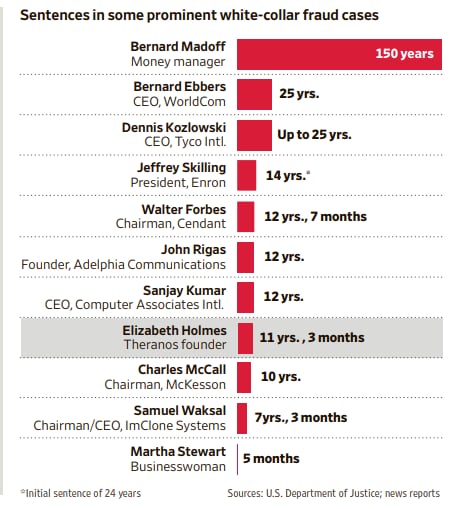
Elizabeth Holmes, the formerly celebrated founder of Theranos, just got hit with a jail term of 11 years, according to the Wall Street Journal.

Along with these, there have been stories about massive layoffs: Meta axes 13 per cent of its workforce, or about 11,000 people; Amazon lays off 10,000 staff, mostly those in core areas such as engineering and marketing; and Google (Alphabet) is under pressure from activist investor TCI to do much the same for cost-cutting reasons.

All this may add up to a “techno-winter” (if not a general recession), one might think; surely the “crypto-winter” is already in progress. But is that really true? I believe there are three separate things going on, and it does not make sense to mingle all of them and seek solutions. The first is just plain old-fashioned grift; the second is the normal churn in business models and the third is whether crypto makes sense.

There are always major scams in the US: examples include Enron, Bernie Madoff, and the Lehman Brothers meltdown. There is the spectacle of supposedly sensible people (e.g. bankers and venture capitalists) being completely bamboozled by a smooth-talking person with a spreadsheet, with the result that lots of investor’s (and taxpayers’) money goes down the drain.

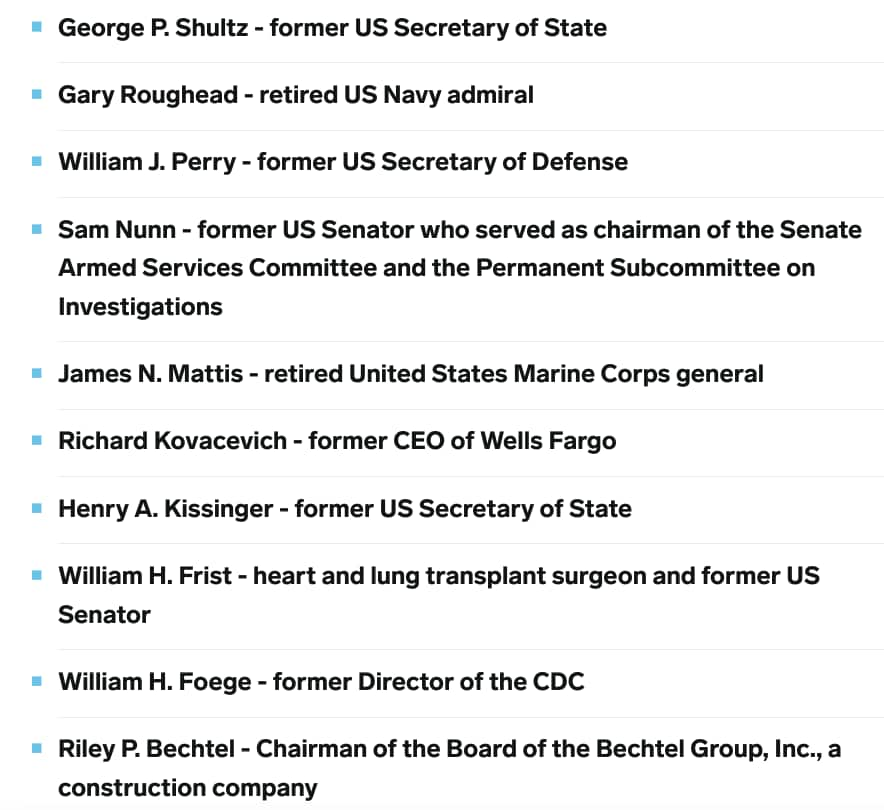
Elizabeth Holmes seems to have hoodwinked the whos-who of not only Silicon Valley’s VCs, but also name-brand politicians and captains of industry and got them on her board of directors. I mean, George Schulz and Henry Kissinger: it doesn’t get any bigger than this. Exactly what did these luminaries see in the company? Some earth-shaking vision, I suppose.

To be honest, I too wondered if Theranos did had a really disruptive technology that would upend the market for diagnostic blood tests. But after an expose in Bad Blood by a WSJ reporter, it was clear that the company was really a house of cards (see my column on this in Open Magazine, where I explored, among other things, Holmes’ ‘reality distortion field’).

It is now clear that Theranos was a scam built up by Holmes and her then-boyfriend, Ramesh ‘Sunny’ Balwani, an Indian-American entrepreneur who was much older than her, who was also president of the company. Holmes has received her sentence; Balwani’s case will come up, and quite likely, he will have the book thrown at him. Bernie Madoff, and Jeff Epstein did. Bernie Madoff is a champion of sorts, for he ran the largest Ponzi scheme in history: $64 billion.

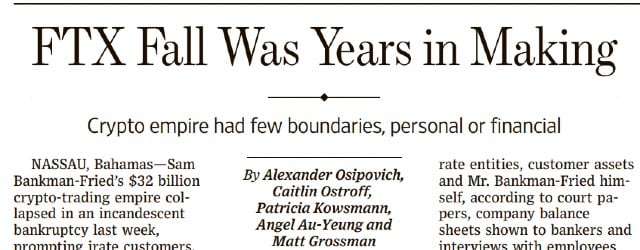
Now Sam Bankman-Fried is giving Madoff a run for his money. His crypto exchange, FTX, valued at $32 billion just a fortnight ago, is worth virtually nothing at this time, and billions of dollars worth of customers’ money has… disappeared. John Ray III, the lawyer brought in to clean up FTX during bankruptcy proceedings (ironically the same person who did the Enron clean-up), said he couldn’t believe the ‘unprecedented mess’ he found there.

The point is that despite all the fuss about crypto-currency, it is increasingly evident that Sam Bankman-Fried ran an old-fashioned fraud: “pump and dump”. The crypto bit was merely window-dressing to give sex appeal to the whole gig. And it worked, too. Major investors like the blue-chip VC firm Sequoia Capital were so thoroughly taken in that the purported reactions of their partners is simply astonishing, if true.

Here’s a screenshot of an alleged Sequoia memo. There’s worse: another tweet purports to show that two partners, a male and a female, reported being sexually aroused on hearing Bankman-Fried’s pitch about FTX’s world-beating vision to control all money (it is too embarrassing and too crude to quote):

Is crypto a scam? Stephen Diehl, author of Popping the Crypto Bubble says so in this interview with the Financial Times. He calls post-2016 crypto the Grifter Era, and that’s not far from the truth. It’s like the carpetbaggers have arrived and set up shop. I am personally of the opinion that crypto may have some value, only that the killer apps haven’t been dreamt up yet; I do believe the underlying blockchains are useful, although successful rollouts are still too few.

But the point is that the FTX meltdown has relatively little to do with crypto per se. It was just a device to dress up a rather standard, old-fashioned fraud or Ponzi scheme. We have seen this sort of thing going even way back: remember the Dutch Tulip Bubble, and the South Seas Bubble. You have fast-talking hucksters hoodwinking gullible investors, who lose their shirts.

It would be unfair to blame crypto for the greed and indiscipline shown by the FTX founder, or the lack of governance and regulatory control which let insiders essentially loot investor funds. For example, here’s Bankman-Fried and Nishad Singh plundering away:

The other angle that’s remarkable is the fact that the meltdown happened just days after the US midterm elections. Coincidence? Hard to believe, because Sam Bankman-Fried had been a major donor to the Democratic party: he donated some $30 million directly to them, and then perhaps a few hundred million to the ecosystem around the Democratic party, especially the media. Said media then lionized Bankman-Fried beyond all reason, as though he were some messiah.

Once again, the media, sadly, is not covering itself with glory. They didn’t do any investigative journalism; and now that the skeletons are tumbling out of the closet, they should be kicking themselves for having missed out on a juicy story. But the omerta of left-leaning, ideological journalists is a wonder to behold. This is what the WaPo is worried about now? Not fraud?

The ‘effective altruism’ school of thought that SBF (Sam Bankman-Fried’s handle) allegedly espoused is probably another scam, even though it’s dressed up in fashionable ESG and DIE memes.Sam Bankman-Fried was the second-biggest donor to the Democratic party before the 2022 midterms (George Soros was the biggest). The website Gateway Pundit quoting someone else (ok, they might have a beef with Democrats anyway, so take it with a pinch of salt) paints a staggering picture of SBF’s political and government connections, which is in itself highly suspicious. All this cannot be mere coincidence.

Did SBF materially affect the midterm election results? I hope the Republican-controlled House of Representatives will launch an investigation.

Frankly this smells like a Deep State operation. I am sure there is a Ukraine angle as well.

More generally, is the US business model facing a crisis?

‘Greed is good’, declared Gordon Gekko in Wall Street. Does modern corporate greed have an origin? In this interview with the Stanford Business School, David Gelles, author of The Man Who Broke Capitalism squarely blames ‘Neutron’ Jack Welch of GE for what he claims is a toxic culture of profit at all cost in US corporations. That may or may not be fair to Welch, but anyway slash-and-burn, as well as short-termism and ideological metastasis seem to be the watchwords of many US CEOs these days.

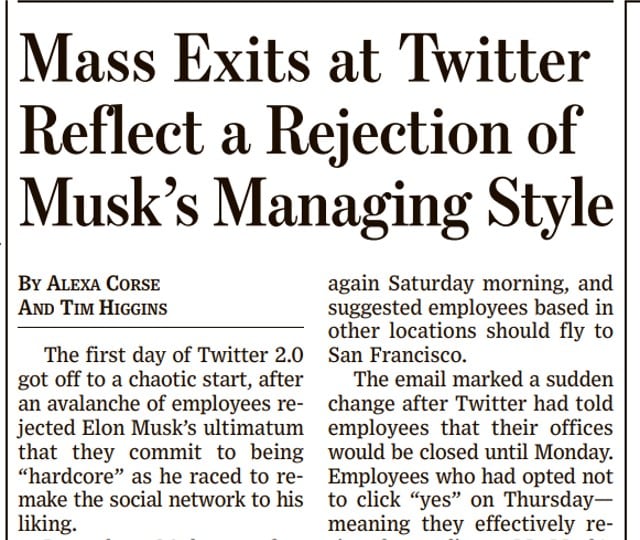
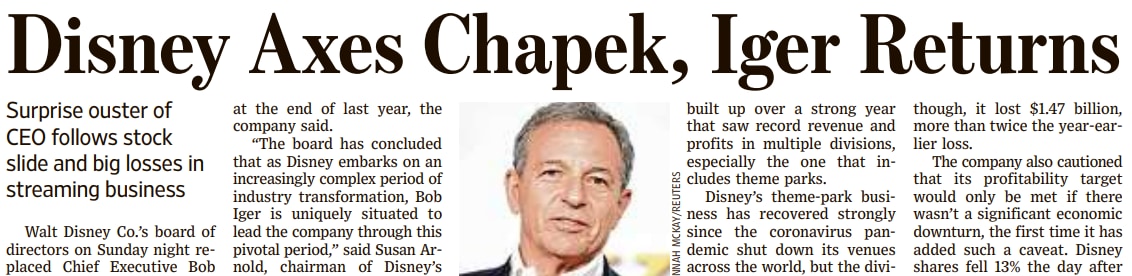
It would be difficult to accuse Elon Musk of seeking undue profit in his $44 billion acquisition of Twitter, which probably is worth much less than that sum just weeks after Musk took it over. But the issue there is, as is probably the case with Disney too, that there is too much ideology permeating the firm. Disney’s recently fired CEO was seriously into woke causes.

What Musk has done is to sweep away the wokeness in Twitter, thereby possibly allowing it to fulfill its purported role of ‘digital town square’. Under the previous dispensation, it had become basically a far-left bubble, because anybody who didn’t fit into their world-view was simply deplatformed, defenestrated, silenced, censored: the very antithesis of Freedom of Speech.

I published this podcast long ago about how the explicit silencing of TrueIndology was a watershed event in the suppression of online speech in India. Shadow banning, reduction of followers, and other malign acts were common against anybody that the Twitter powers-that-be didn’t consider to fit their views, which in India meant anti-Hindu perspectives.

Despite all the noise in the media about how Twitter has gone down the drain, it is entirely possible that Musk will not run it into the ground. Advertisers who are now staying away will most likely return. The savage layoffs don’t seem to have materially affected the actual performance of Twitter on the ground, as it were: so was there a lot of waste? Wokes are known to live well off Other People’s Money, as in the very case of FTX (in the Bahamas), per the WSJ.

I am betting that Elon Musk will be able to return Twitter to some semblance of a business model, not run it in the ground. After all, the platform does offer value to its subscribers, even long-suffering shadow-ban victims such as me (I have often found people I’ve never heard of have blocked me: I am apparently on mass-blocking lists) still find it useful.

It is not clear, though, if the ‘greed at all costs’ attitude of US business will survive. It is clear, for instance, that they have surrendered America’s industrial capacity to China in the last 30 years, all in return for short-term profits from the ‘China price’. This is suicidal in the long run, as they are beginning to now realize. There has to be some introspection.

It may be too grand to claim that Western business will now go through a sea-change, a once-in-a-generation shift to something more accountable to national interests. This is especially hard when the Deep State is so ascendant, and its friends in the military-industrial-complex thrive on war in Other People’s Countries.

But these woes are coming at the very time that we are seeing the limits of globalization and to the excesses of Wall Street and Silicon Valley VCs. The US business community, and regulators, should consider FTX and Theranos to be canaries in the coalmine: there are useful lessons in their failures.

The writer has been a conservative columnist for over 25 years. His academic interest is innovation. Views expressed are personal.

Read all the Latest NewsTrending NewsCricket NewsBollywood News,
India News and Entertainment News here. Follow us on FacebookTwitter and Instagram.


from Firstpost World Latest News https://ift.tt/1vCL34a

Rise of the People: As COVID protests spread, a brief history of rare acts of dissent in China

Fed up and angered with the stringent zero-COVID policy, thousands of protesters hit the streets in China over the weekend.

As per media reports, some have even called for Chinese president Xi Jinping to step down. The protests began on Friday (25 November) and soon spread to many cities including Shanghai, Beijing, Chengdu, Guangzhou and Wuhan. Dozens of university campuses in China also witnessed demonstrations.

This widespread dissent against the ruling Chinese Communist Party (CCP) in decades was triggered after a deadly fire broke out and killed at least 10 people in an apartment building in the north-western city of Urumqi, reports Associated Press (AP). Lockdown rules were blamed for hindering rescue efforts, but Chinese authorities have denied these claims.

How China has resisted the strict zero-COVID approach so far? When have the people held major protests in the country earlier? Let’s take a closer look.

China protests against zero-COVID policy

Even though the recent protests have made the most noise globally, this is not the first time China has revolted against Xi’s stringent COVID-19 policy which includes snap lockdowns, travel restrictions, mass testing and quarantines.

According to China Dissent Monitor (CDM), a total of 668 cases of dissent were reported from June to September this year in the country, out of which 37 incidents were related to COVID measures.

Citing the CDM report, Freedom House said that the other cases of dissent were related to stalled housing projects (215), pay and benefits (109), fraud (105), building quality (43), and school district disputes (37), among other reasons.

Meanwhile, during the current protests, chants of “step down, Xi Jinping! step down, Communist Party!” were heard in the financial hub Shanghai, reported CNN.

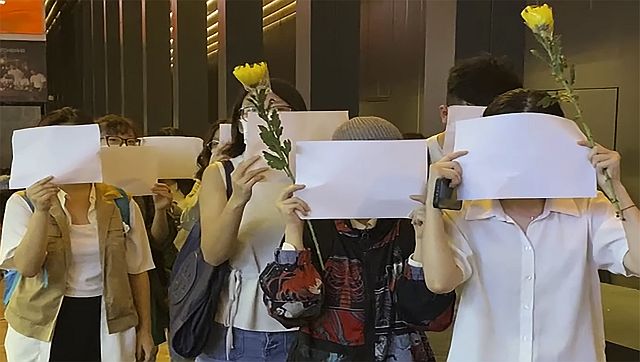
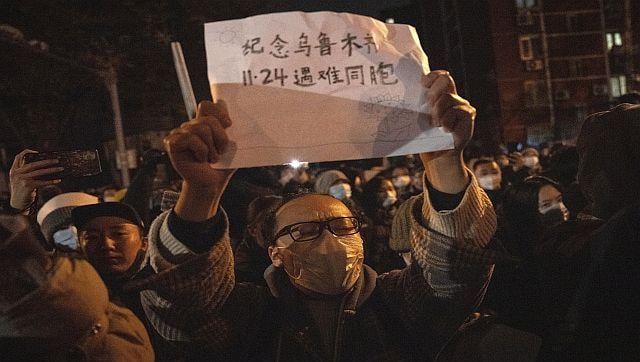
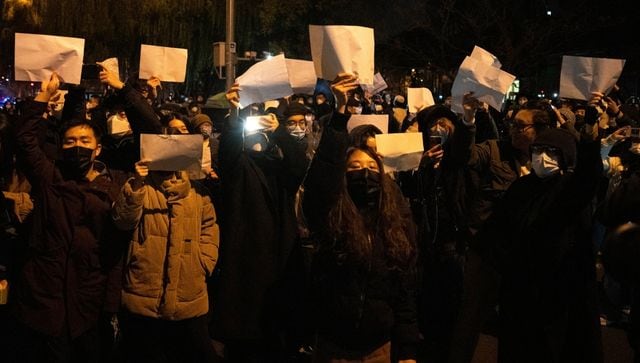
Many demonstrators held blank pieces of white paper – a symbol of defiance against the ruling party’s censorship.

“The lockdown policy is so strict,” Li, a protester told AP. “You cannot compare it to any other country. We have to find a way out.”

china covid protests

After the deadly fire, hundreds of protesters also gathered outside Urumqi’s government offices calling for authorities to “lift lockdowns!”, reported NDTV.

According to CNN, some agitators also rallied behind cries of “Don’t want Covid test, want freedom!” and “Don’t want dictatorship, want democracy!”

BBC reported that in Shanghai police officers on Sunday arrested several protesters and cordoned off streets. A BBC journalist, who was covering the protests there, was reportedly assaulted and detained, before being released after hours.

As per NDTV report, censorship has begun in China with words such as “Liangma River”, “Urumqi Road” – protest sites in Beijing and Shanghai – being removed from Weibo, a Twitter-like platform.

Despite its stringent policy, China has recently seen a rise in coronavirus cases with 40,052 daily infections being reported on Monday, NDTV reported. Following the spurt in COVID-19 cases, many cities in China have resorted to stern measures to stem the transmission.

ALSO READ: China’s COVID Conundrum: Why the virus is showing no signs of slowing down

Sitong bridge protest

In October this year, a lone man in China had reportedly sparked protests around the world. Dubbed ‘Bridge Man’, the mystery protester strung two large banners on the Sitong bridge in the Haidian district of Beijing on 13 October.

The banners featured slogans that called for the withdrawal of China’s zero-COVID policy and the ouster of President Xi, Reuters reported.

“We want food, not PCR tests. We want freedom, not lockdowns. We want respect, not lies. We want reform, not a Cultural Revolution. We want a vote, not a leader. We want to be citizens, not slaves,” one of the banners said, as per The Guardian.

The Beijing authorities quickly removed the signs of the rare protest that came a few days ahead of the 20th Communist Party congress.

According to VoiceofCN, a group of anonymous Chinese nationals who run a pro-democracy Instagram account, in October, the slogans against the Chinese government had ‘clandestinely’ appeared in at least eight Chinese cities including Shenzhen, Beijing and Guangzhou, as well as Hong Kong, Bloomberg reported.

Tiananmen Square protests

One of the most significant pro-democracy protests in China took place in Beijing’s Tiananmen Square in 1989.

The student-led protests expanded in the spring of 1989 following the death of Hu Yaobang, a Communist Party leader who wanted to liberalise politics in the country.

In late April, thousands of mourning students assembled at Tiananmen Square, one of Beijing’s most famous landmarks, notes BBC.

They called for more freedoms and an end to press censorship. Over the coming weeks, the number of protesters swelled at the site, leading to martial law being declared in Beijing in late May.

Between 3 to 4 June, the People’s Liberation Army reached Tiananmen Square with orders to clear the site. Around 2,00,000 troops and over 100 tanks moved towards the protest site, opened fire, and arrested demonstrators to crush the dissent.

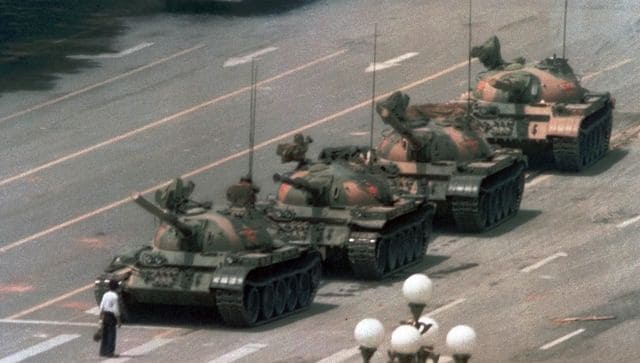
On 5 June, a lone man – an image that remains one of the most powerful photos of a protest – stood in front of a line of tanks and was successful in halting the convoy for a while, reports National Geographic.

It remains unknown what happened to the unidentified protester who is famously known as ‘Tank Man’.

1989 Tiananmen Square protests

According to the Chinese government, 200 civilians were killed in the protests. However, student leaders put the death toll at 3,400, reported National Geographic.

A secret diplomatic cable released by the United Kingdom in 2017 claims that around 10,000 people had died, as per BBC. 

Falun Gong protests

Falun Gong, a spiritual exercise practice, has been banned in China since 1999.

As per Australian Broadcasting Corporation (ABC), in April 1999, around 10,000 Falun Gong practitioners had held a silent protest outside the Communist Party headquarters in Beijing against ‘defamatory’ reports about the group in the state media.

The government responded by saying that Falun Gong had “created disturbance and jeopardised social stability”. Soon, the movement was banned and termed an “evil cult”.

In 2000, The New York Times reported that the Chinese government’s actions against the Falun Gong, “have led to at least a dozen deaths, alleged death by torture, thousands of cases of abuse and the harassment of tens of thousands… ”

Human-rights groups reported in 2009 that as many as 2,000 people had been killed in the crackdown against the Falun Gong, Seattle Times reported.

In 2014, Chinese lawyers told AP they were subjected to torture by the police for protesting along with relatives of Falun Gong members.

Wukan protests

Wukan, a village in China’s southern Guangdong province, had made headlines in late 2011 when the people demanded their land back which was secretly sold by members of the village committee, as per Al Jazeera. 

The villagers were successful in ousting the village committee and later democratic elections were held. Local Communist Party secretary Lin Zuluan, one of the leaders of the 2011 rebellion, was elected as the village chief in the elections.

In 2016, Lin threatened to launch protests to press for compensation for the land the villagers said was stolen from them by corrupt officials, BBC reported.

However, Lin was arrested and sentenced to 37 months in prison for “corruption” in September of that year.

As per BBC, from primary school children to elderly fishermen, protesters stormed the street demanding  “Free Lin Zuluan!” and “Return our land!”

However, the agitation was crushed and the demonstrators were told — to stop or face the consequences’, BBC reported.

Al Jazeera report said that over 100 people were arrested for joining the protest and the police also beat protesters including old women and children.

With inputs from agencies

Read all the Latest NewsTrending NewsCricket NewsBollywood News,
India News and Entertainment News here. Follow us on FacebookTwitter and Instagram.


from Firstpost World Latest News https://ift.tt/w3PSMDx

Trudeau-Xi showdown at G20 meet: How Canada can tackle Chinese interference

In April 2021, Conservative MP Kenny Chiu was so concerned about potential Chinese interference in Canada’s political system that he proposed a Foreign Influence Registry Act similar to those in the United States and Australia. The act requires anyone acting on behalf of foreign interests to be publicly identified.

Soon after, bots were mobilised and a disinformation campaign was waged against Chiu on Chinese social media platforms, including WeChat and Weibo, calling him “anti-China,” misrepresenting the legislation and playing a role in his loss in the September 2021 election.

Half of Chiu’s riding of Steveston-Richmond East in British Columbia’s Lower Mainland is comprised of Chinese-Canadians. His loss represented a big win for China using the very disinformation methods the MP had been flagging. It’s believed other federal candidates were also targeted.

Global News recently reported that intelligence sources believe China’s Toronto consulate interfered in the 2019 federal election by providing $250,000 in funding via a Communist party proxy group to an alleged election interference network.

The group allegedly targeted at least 11 candidates in both the Liberal and Conservative parties whose victory China wanted to secure. Beijing also allegedly placed staffers in certain MPs’ offices to influence policy.

Dispersing funds

A subsequent Global report identified a Toronto businessman who allegedly dispersed funds from China’s Toronto consulate through Canada-China associations and ultimately to election campaigns — strictly illegal in Canada under the Canada Elections Act.

The businessman is also being investigated for his potential role in supporting so-called “Chinese police stations” that were identified in Canada by an international human rights think tank called Safeguard Defenders.

These stations, identified so far in Toronto and Vancouver, allegedly house Chinese police agents who pressure selected individuals to return to China to stand trial for corruption, or join family members in indoctrination camps and prisons in the Xinjiang region of the country.

The Chinese Embassy says the stations simply issue driving and health cards to Chinese nationals. Investigations are ongoing, not just in Canada but also in 13 other countries where similar stations have been identified.

To his credit, Prime Minister Justin Trudeau raised his concerns about China’s interference in Canada in a face-to-face encounter with Xi Jinping at the recent G20 meeting in Bali.

Trudeau did not relay what Xi said in response, but the Chinese leader was angry enough about their discussion being reported by the media that he confronted the prime minister the next day, accusing him of “inappropriately” leaking details of the conversation to reporters.

Trudeau stood his ground, responding:

“In Canada we believe in a free and frank and open dialogue, and we will continue to work constructively together. But there will be things that we disagree on.”

He’s to be commended for conveying that Canada will not stand for Chinese interference in Canadian political affairs. But what is the government doing now to hold Chinese individuals and organisations accountable? And what should it do?

Five steps in taking action

The most immediate imperative is for the police to investigate the funding allegedly provided by the Chinese consulate in Toronto to the 11 candidates, charging any Canadian who has subverted the Canada Elections Act and expelling any consulate or embassy staff also implicated.

Security clearances of the people identified in MPs’ offices should also be verified immediately.

Second, Canadian authorities need to become much more sophisticated about tracking cyber attacks, social media bots and misinformation, and developing tactics to deal with them.

We could learn from Taiwan, which has faced these issues for years amid the “cognitive warfare” China has waged against it. Taiwan has a minister of digital affairs whose job includes ensuring the posting of accurate information via a public dashboard, as well as cyber-tracking experts whose experience would also benefit Canadian authorities.

Third, for those Canadians of Chinese, Uyghur and Tibetan descent as well as Falun Gong followers, there should be a single office created that allows them to report harassment and then coordinate with other forces as necessary regarding the appropriate investigation and legal action.

This isn’t a new proposal. The Canadian Coalition on Human Rights in China and similar associations have been calling for such an office for some time.

Fourth, the Foreign Influence Registry Act championed by former MP Chiu should be re-introduced, but this time by the government itself rather than an individual MP who may consequently be targeted with a Chinese misinformation campaign as he was.

Bill S-237, now in the Senate, is a good first draft that will ensure transparency about the people who are acting on behalf of foreign interests in Canada.

Finally, the government should introduce comprehensive foreign interference legislation as the United Kingdom did earlier this year as part of its National Security Act.

It’s designed to disrupt and deter foreign interference and hold those responsible to account. It also increases the penalties under existing British election laws.

In Canada, the maximum fine of $250,000 and maximum six months in jail for foreign interference may not be a sufficient deterrent to some.

‘Increasing in scale’

RCMP national security sources are making clear that “incidents of CCP interference operations are increasing in scale, intensity and brazenness, and investigators and community sources are expressing alarm and fear for Canada’s institutions.”

The government must act on these serious challenges to Canada’s democracy.

In recent weeks, Trudeau and his senior Cabinet ministers have demonstrated courage in standing up to China. But words aren’t enough.

Rhetoric must be matched with serious action. The issues are too urgent for complacency.The Conversation

This article is republished from The Conversation under a Creative Commons license. Read the original article.

Read all the Latest News, Trending News, Cricket News, Bollywood News,
India News and Entertainment News here. Follow us on Facebook, Twitter and Instagram.


from Firstpost World Latest News https://ift.tt/f9GpYyR